
There's a persistent stereotype in poker: small bet = weak hand. When you fire a 25% pot bet on the river, your opponent's first instinct is often "they're not confident." But if that's all you see in block bets, you're missing one of the most important strategic discoveries of the solver era.
The river block bet isn't merely a "thin value" tool. Its true power lies in this: when you're out of position (OOP), it transforms you from "passively waiting for the opponent to decide" into "actively controlling where the pot goes." More importantly, it directly strips the in-position player of their ability to build a polarized range and apply maximum pressure against you.
Put differently, you constantly hear about "how to extract maximum value" — but is there a tool that can consistently suppress your opponent's ability to extract maximum value from you? The block bet is one of the best answers to that question.
This article approaches from an angle you rarely hear: the block bet as a defensive weapon — which board textures favor it, when checking is actually better, and how to build a decision framework for timing your block bets.
How Bet Sizing Changes Your Opponent's Defense Obligations
To understand why block bets work, you need to grasp a core mathematical concept: Minimum Defense Frequency (MDF). It determines what percentage of their range your opponent must continue with to prevent your bluffs from automatically profiting.
For example: facing a 50% pot bet, , meaning the opponent must continue with 67% of their range.
The key insight: the smaller the bet, the higher the required defense frequency. Against a 25% pot bet, the opponent must continue with 80% of their range; against 75% pot, only 57%. That gap is enormous — 80% defense means the opponent must call with extremely weak hands to maintain equilibrium, and virtually nobody does this in practice. This is the mathematical foundation of block bets: they force the opponent into a "should call in theory but won't call in reality" dilemma.
What Is a Block Bet?
A block bet is a small wager below 40% of the pot, most commonly used by the out-of-position (OOP) player on the river. Its strategic purpose isn't singular — it simultaneously serves three objectives:
- Extract thin value from weaker portions of the opponent's range — hands that would fold to a standard 50-75% bet
- Lose less when running into the stronger part of the opponent's range — you're only risking a small bet
- Prevent the in-position opponent from constructing a polarized betting range — this is the most underappreciated benefit
Core Mechanism: How Block Bets "Suppress" Your Opponent
Imagine a common river scenario: you're OOP with a medium-strong hand — say, top pair with a medium kicker. What happens if you check?
You hand full control to the in-position opponent. They can construct a polarized range of nut hands and selected bluffs, choose a bet size that turns your decent hand into a pure bluff catcher. Your top pair medium kicker was a solid hand, but facing a 75% pot or overbet, it suddenly becomes an agonizing coin flip — call or fold with virtually no edge.
But if you lead with a 25-33% block bet, the entire dynamic flips:
- The opponent's weak hands (KJ, JT, TT, A9s, K9s, 98s, 88, etc.) can no longer see a free showdown — they're forced to make a call-or-fold decision
- If the opponent's nut hands want to raise, they must operate in a pot that already contains your bet — their raise sizing is constrained, and you've pre-defined the pot size
- The opponent loses their privilege of choosing the perfect bet size to polarize — you act first, they can only react
"The essence of a block bet isn't showing weakness — it's preemptively defining the battlefield on the river. You're not asking the opponent 'how do you want to play?' — you're saying 'I've decided where this pot is going. Your move.'"
Why This Line Prints Money
Block bets generate profit from two directions simultaneously:
Direction 1: Thin Value Extraction
Your medium-strength made hands (top pair weak kicker, middle pair strong kicker, etc.) can't extract value with standard sizing — the opponent's weak hands fold and only stronger hands call. But a 25% pot bet attracts hands that would fold to a large bet yet are willing to "pay to see" against a small one.
Simultaneously, even when called or raised by a stronger hand, your losses are contained to a small bet. This "upside capture with downside control" risk structure is the mathematical beauty of the block bet.
Direction 2: Low-Cost Bluffing
This is the part most players overlook. Returning to the MDF formula: facing a 25% pot bet, the opponent theoretically needs to defend 80% of their range. That defense frequency is absurdly high — even experienced pros struggle to actually call with hands like 88, 76s, or even 66 on the river, even when theory demands it.
Real-world population tendencies make the situation even more favorable. Since most players don't slow-play sets, straights, and two-pairs on the turn as frequently as the solver does, they arrive at the river with a weaker range than theory predicts — meaning they have more hands that should fold. The result: your block bet bluffs encounter massive overfolding.
This population bias yields two practical implications:
- You should value-bet thinner — your medium hands have more equity because the opponent's range is weaker
- You should bluff more frequently — the opponent will significantly overfold, making your low-cost bluffs automatically profitable
When to Block Bet and When to Just Check: Board Texture Matters
Block bets aren't universal — on the wrong board texture, their EV can actually be lower than checking. The key lies in three dimensions: the board's "nut density," how much your range and your opponent's range overlap, and how the river card shifted both ranges.
Ideal Block Bet Boards: Static, Low Nut Density
The best block bet boards are those where "nobody is likely to have the nuts." For example:
- Dry rainbow boards (e.g., K-7-2-J-4 rainbow): No flush is possible, straight combinations are minimal, and both ranges are dominated by pairs and high cards. On these boards, your top pair medium kicker is hard to polarize against — because the opponent simply doesn't have many nut combinations (sets, two pair)
- Paired boards (e.g., 9-9-5-K-3): Paired boards compress everyone's range. Besides the rare trips or full house, everyone holds one pair or two pair. Block bet thin value space is enormous here because the gap between "good hands" and "decent hands" is narrow
- River is an irrelevant low card (brick): When the river completes no draws, both ranges are essentially frozen from the turn. Block bets are safest here — the opponent is unlikely to suddenly hold the nuts
Dangerous Block Bet Boards: Dynamic, High Nut Density
Some board structures make block bets risky:
- River completes an obvious flush or straight: When the third or fourth flush card lands, or a straight completes, the opponent's range polarizes sharply — they either made the nuts or completely missed. Your block bet gets crushed by nut hands, while missed draws weren't paying you anyway
- Boards with high nut combination density: For example, a J-T-9-8 structure where any Q or 7 makes a straight. On these "nut-dense" boards, your medium-strength hand doesn't face "the opponent might have the nuts" — it faces "the opponent probably has the nuts." Block betting here just gives them a cheap raising opportunity
- Your range is clearly capped: If preceding streets' actions indicate you're unlikely to hold the nuts — e.g., you just called a wet flop bet — sharp opponents recognize your block bet range caps at medium strength and will aggressively raise accordingly
The Gray Zone: A Decision Tree for Check vs. Block Bet
Most river scenarios aren't black and white. When you're OOP on the river with a medium-strength hand and unsure, use this decision flow:
- Did the river complete a major draw? If yes → lean toward checking. The opponent's range just got polarized, and your small bet will get crushed by nuts
- Does the opponent's range contain many nut combinations? If few (dry/paired boards) → lean toward block betting. Your risk of facing a raise is low, and thin value space is large
- Has your range been capped by your action sequence? If yes → consider checking. When your range ceiling is obvious, a block bet may invite exploitative raises
- Does this opponent tend to over-raise or over-fold? If they're passive (most low-mid stakes players) → block bet EV is higher, because they're unlikely to punish your small bet
- Does your hand have showdown value? If it's pure air → block bet works as a cheap bluff; if it's a medium made hand → block bet serves dual purpose of thin value and avoiding a big bet
The core logic of this decision tree: block bet EV advantage is greatest on "static" and "low nut density" boards, and smallest (or even negative) on "dynamic" and "high nut density" boards.
Why IP Players Almost Never Block Bet
Block bets are primarily an OOP weapon. In position, solvers rarely recommend block betting. The reason lies in OOP's defensive mechanism: when the solver plays OOP, it preemptively defends against thin value bets by checking with many nutted hands, then punishes IP's thin bets with large, balanced check-raises. This means IP block bets face not passive calls, but potentially devastating raises.
So remember this principle: the block bet is your best option when you're OOP on the river with a hand that's "too good to check, too risky to bet big." Its existence condition is clear — you have a hand that wants thin value but fears facing a large bet, and you're out of position.
Practical Extension: Using PokerAlpha to Analyze Block Bet Spots
Once the theoretical framework is established, the real challenge is making quick judgments at the table: "should I block bet this spot?" PokerAlpha's Coaching feature helps you do exactly this — you can ask the AI about any river decision point with "should I block bet here?", and it provides specific analysis based on board texture, both players' ranges, and opponent tendencies.
Here's a real example: a player holds 9♠︎7♣︎ in a deep-stacked game, and the river brings a four-club board. They ask whether to block bet.
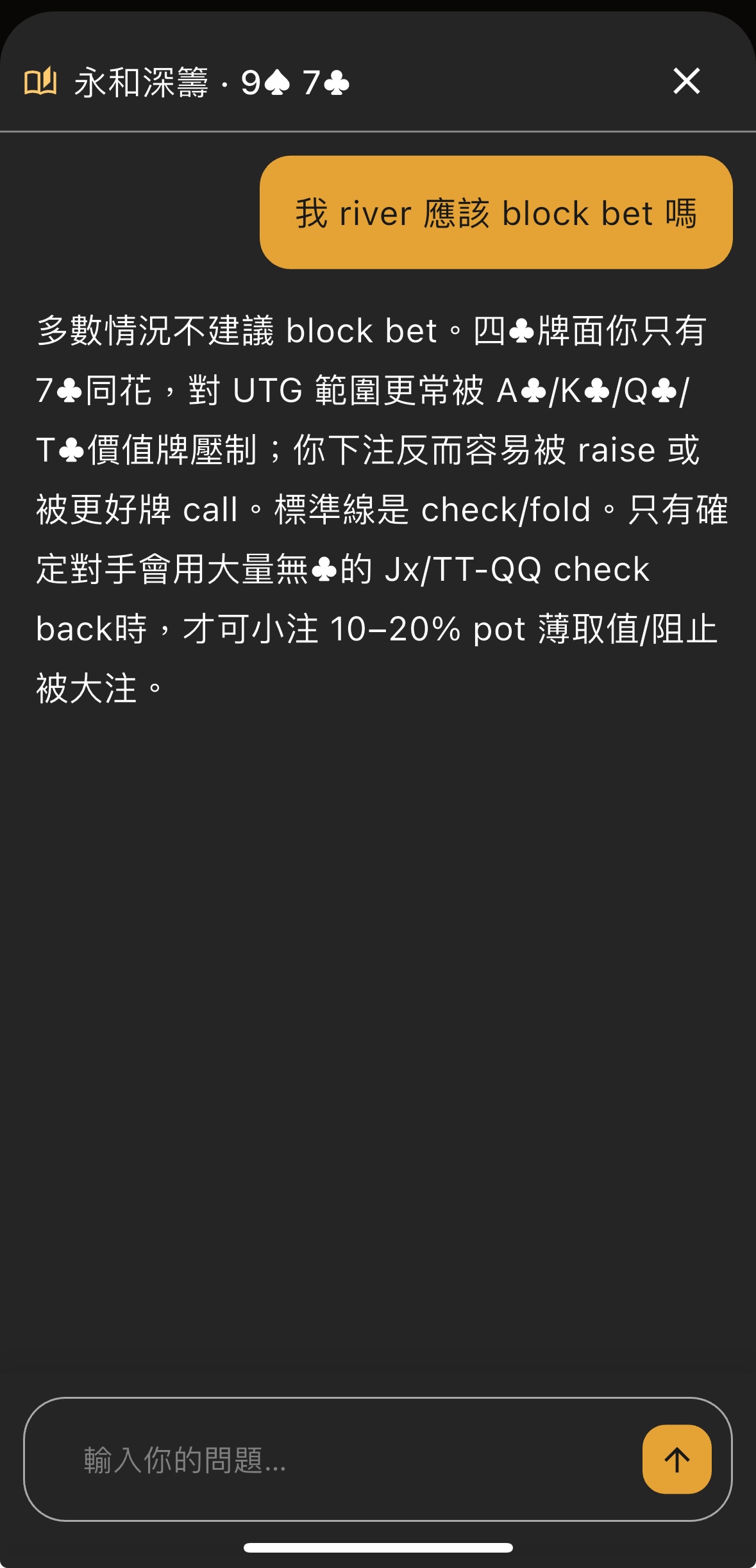
The AI response pinpoints the issue: block betting is not recommended on this board. With four clubs out and only the 7♣︎ for a flush, the hand is commonly dominated by A♣︎/K♣︎/Q♣︎/T♣︎ value hands in the UTG range. Betting invites raises or calls from better hands. The standard line is check/fold — only when you're confident the opponent will check back with many non-club Jx/TT-QQ hands should you consider a small 10-20% pot bet for thin value while blocking a large bet.
This perfectly echoes our decision tree: river completes a flush (high nut density) + your range is capped → don't block bet. The difference is that PokerAlpha doesn't just tell you "don't block bet" — it tells you why, and under what conditions an exception might apply. This kind of hand-by-hand real-time feedback helps you internalize the theoretical framework from this article into genuine table instinct.
Conclusion
The river block bet is one of the rare strategies in poker that simultaneously accomplishes offense and defense. It lets you extract value from weak hands your opponent wouldn't voluntarily pay with, while preventing them from pressuring you with a polarized range. It minimizes your bluffing costs while forcing opponents to make decisions in spots they're overwhelmingly likely to misplay.
Next time you're OOP on the river with a "not great, not terrible" hand, don't just think "check or bet big." Ask yourself: is a 25-33% pot bet actually the highest-EV option? The answer might surprise you.
References
- [1]Upswing Poker — The River Block Bet: Why Small Bets Can Be Your Biggest EdgeIn-depth breakdown of river block bet solver foundations and practical exploit strategies
- [2]Upswing Poker — Beyond the Flop Overbet: Elite-Level Turn Play ExplainedFurther reading on leveraging different bet sizes to build strategic advantages on the turn